
|
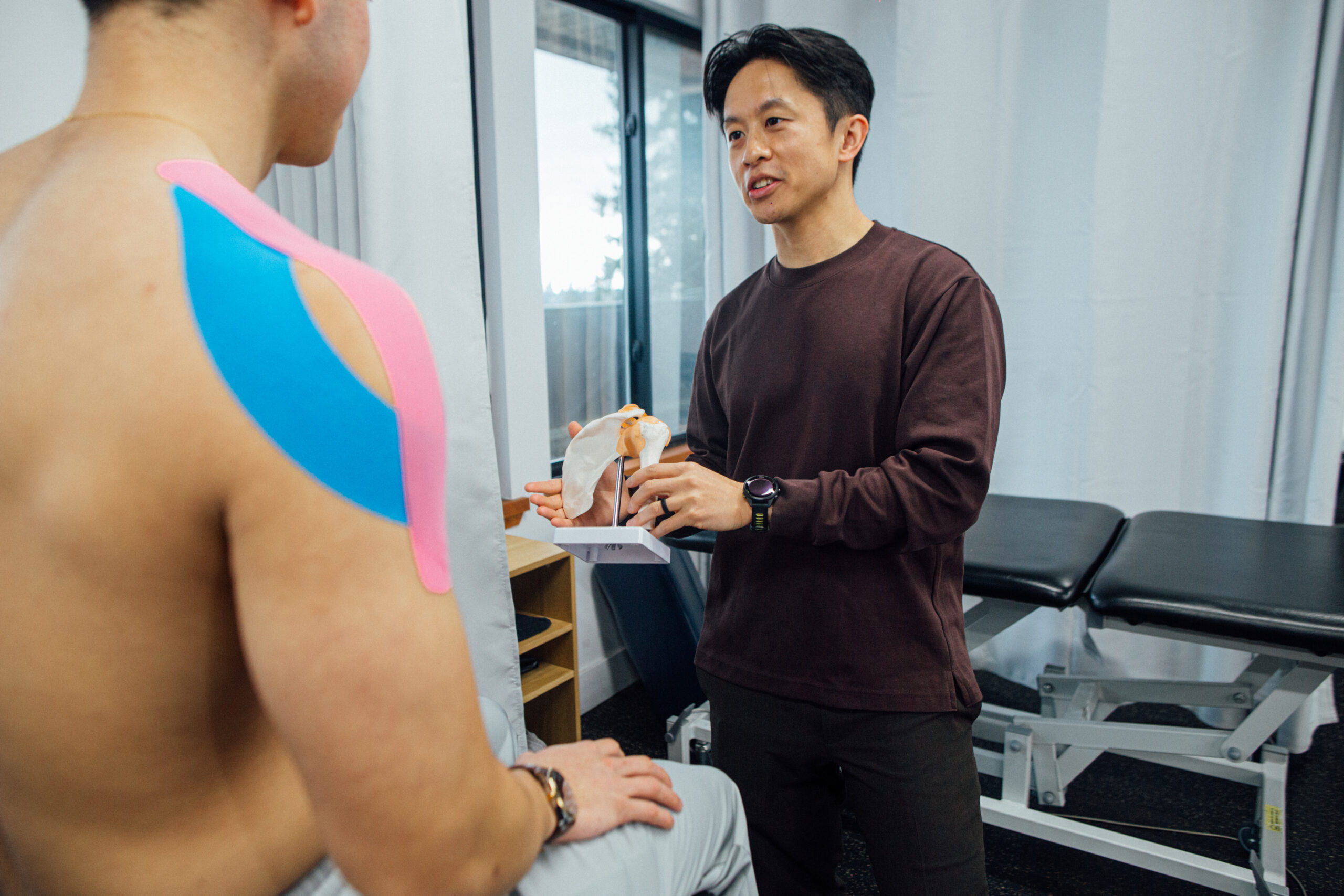
Shoulder Pain Coquitlam — 2026 Guide Shoulder pain is rarely just a shoulder problem.At Coquitlam Physio & Health, Charles To (MScPT) uses strategic Kinesio-Taping and biomechanical analysis to provide immediate stability and re-train your rotator cuff — getting you pain-free today while building long-term resilience for tomorrow. |
|

Your Top Shoulder Questions Answered
1. Why does my shoulder hurt when I lift my arm?
This is often Shoulder Impingement — when the tendons of the rotator cuff are pinched as they pass through a narrow space in the joint. Charles To analyzes your scapular rhythm — how your shoulder blade moves when you reach up — to determine whether the cause is a muscle imbalance, poor posture, or a structural block that needs a different intervention.
2. How does taping actually help my shoulder pain?
Mechanical SupportHigh-tension athletic tape physically limits harmful movements — acting as an external ligament when your own ligaments are compromised. This is the tape you see on injured athletes competing at high levels. |
Neurological FeedbackKinesio-tape lifts the skin slightly, improving blood flow and sending a constant signal to your brain about your shoulder’s position. Charles uses this to remind your muscles to stay active — even when you aren’t thinking about it. |
3. Can I tape my own shoulder at home?
“The shoulder is the most mobile joint in the human body. Incorrect taping can actually increase impingement or cause your muscles to turn off when they should be working. The tension and direction must be calibrated to your specific injury.”
— Charles To, MScPT
While DIY videos exist, self-taping the shoulder without clinical guidance carries real risk. Whether it’s an AC joint sprain, a labral tear, or a simple strain — the tape application changes significantly between each condition. Charles To ensures every application is precise, safe, and purposeful.
4. Is taping a permanent fix?
No — and that’s by design. At Coquitlam Physio & Health, we see tape as a bridge. It reduces pain today so you can perform the strengthening exercises needed for a permanent fix tomorrow. Once Charles stabilizes the joint, he works with Cole Iantorno and Tristan Dy Tang to progressively load the shoulder and build the long-term resilience that tape alone cannot provide. If your shoulder injury was caused by an ICBC accident, taping and physio are covered at $0 out-of-pocket.
The Integrated Advantage: The Charles-Cole-Tristan Pipeline
Charles To doesn’t just look at the shoulder in isolation. He examines how your neck, upper back, and core all contribute to your shoulder’s instability — because that’s where most shoulder injuries actually start.
|
Stage 01 — Charles To Diagnose & StabilizeBiomechanical assessment, scapular rhythm analysis, and precision taping to provide immediate pain relief and joint control. |
Stage 02 — Cole Iantorno Load & StrengthenProgressive rotator cuff and scapular stabilizer loading to build the structural support the shoulder needs to function tape-free. |
Stage 03 — Tristan Dy Tang Perform & PreventSport and work-specific conditioning to ensure the shoulder can handle real-world demands without breaking down again. |
Related Reading
|
Stop Guessing With Your Shoulder Pain.Whether it’s impingement, instability, a rotator cuff issue, or frozen shoulder — Charles To has the biomechanical expertise to identify the root cause and build your roadmap back to full, confident movement. |