
Chronic Ankle Instability (CAI) occurs when the ligaments and neurological sensors of the foot fail to communicate effectively with the brain, leading to a cycle of giving way and re-injury. At Coquitlam Physio & Health, our physiotherapy team utilises a Triple-Threat Assessment to break this cycle. By combining orthopedic precision, biomechanical gait analysis, and neuromuscular re-education, we transform unstable ankles into durable foundations for high-performance movement.
TL;DR: The Ankle Success Path
|
The Patient: “Glass Ankle” Syndrome
Meet “David,” a 29-year-old local firefighter and mountain biker. For years, David struggled with what he called glass ankles. A simple misstep on a curb or a tree root would result in a painful roll and a week of swelling. He had tried elastic braces and basic calf raises — but the instability remained. David didn’t just have a weak ankle. He had a neurological lag — his brain wasn’t catching his falls before they happened. This same neurological delay is what our team addresses in concussion and vestibular rehab — the nervous system simply isn’t processing fast enough.
“David’s issue wasn’t strength — it was timing. His ankle was physically capable of stabilizing itself, but his nervous system was reacting 200 milliseconds too late. That’s the gap we had to close.”
— Jayten Patel, MPT, CSCS
The Triple-Threat Assessment: Three Lenses, One Plan
At Coquitlam Physio & Health, David didn’t just get a generic set of exercises. He received the full Integrated Clinical Blueprint — the same three-lens approach we use for knee pain and back pain.
|
Lens 01 — Edmund Gu, PT The Orthopedic CheckEdmund identified a bony block in David’s talocrural joint. Because the joint wasn’t gliding correctly, David’s muscles were working overtime to compensate — leading to premature fatigue and vulnerability on uneven terrain. |
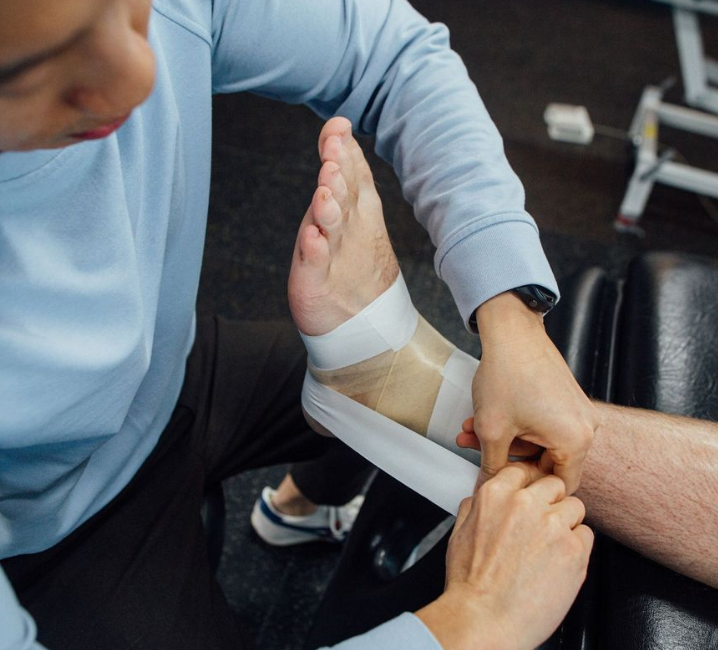
Lens 02 — Charles To, MScPT The Gait AnalysisCharles To identified that David’s hip stabilizers were lazy, causing his foot to land in an inverted position. He applied high-tension athletic taping to physically guide David’s foot into a safer strike zone while re-training the pattern. |
The Neuromuscular ResetJayten identified the root cause — poor proprioception. He used reactive drills to force David’s nervous system to wake up and react faster than the injury could occur. |
The Intervention: Building the “Internal Brace”
The entire rehab strategy focused on one goal — moving David from passive support (external braces) to active stability (his own neuromuscular system). Each phase built on the last:
The Result: Confident Movement
After eight weeks of integrated care, David’s glass ankles were gone. More importantly, his confidence returned. He no longer looked down at his feet while hiking — he trusted his body to react. We don’t just treat the joint — we optimize the athlete. If David’s ankle injury had occurred in a motor vehicle accident, this entire program would have been covered at $0 under ICBC.
Jayten Patel, MPT, CSCSReactive Stability Lead Master of Physical Therapy specializing in reactive stability and neuromuscular re-education. |
Charles To, MScPTGait & Taping Lead Specialist in biomechanical gait analysis and athletic taping for ankle and lower limb injuries. |
Edmund Gu, PTOrthopedic Lead Senior lead for orthopedic trauma and manual joint mobilization — including talocrural and subtalar joint work. |
Related Reading
|
Tired of Rolling Your Ankle?Chronic ankle instability isn’t just bad luck — it’s a solvable neurological problem. Book your integrated ankle assessment with our Triple-Threat team today and stop the cycle of sprains for good. |